Founder-led systematic trading research

A question
worth investigating.

Your team has a research question.
I bring the technical direction, the framework and the agents to investigate it.

Discuss your research

Prefer to explore first? Take a private guided look at the research environment.

A LOOK INSIDE THE PROCESSQUESTION → FINDINGS
Signals. Strategies. Portfolios.Your instruments. Your constraints. Your decision.↓

01 Where we begin

Start with your question.

Three questions your team could bring to us. Choose an example to see what I would investigate.

AN EXAMPLE RESEARCH QUESTION

Does this data tell us something we don’t already know?

I compare the new source with the information your team already uses, checking when it was available and what it adds.

WHAT WE INVESTIGATE
Compare what the extra information adds.Illustrative research example, not a result.

Have a question like this?

Discuss your research

02 How the work moves forward

Every experiment
should answer something.

Follow one question from the initial brief to my recommendation. Scroll to see how each step builds on the last.

01 / FRAME

Framing
the question.

We agree what you want to find out, which instruments and data to use, and how we will judge the evidence.

Your brief can begin with a market observation, a new source of information or a portfolio objective. We turn it into a research question with explicit constraints.

A shared starting pointThe question, the scope and what the research needs to establish.

02 / INVESTIGATE

Investigating
the assumptions.

Agents investigate the available evidence. I direct the work toward a testable explanation, including what would contradict it.

They explore the data and its documentation, connect relevant findings and record their reasoning. The aim is to choose experiments for a reason, rather than try every variation.

A reason to experimentA hypothesis grounded in evidence, with its assumptions recorded.

03 / EXPERIMENT

Building
the experiment.

The hypothesis becomes versioned code, with tests and static checks. We evaluate it with applicable trading costs and documented assumptions.

Each experiment tests a specific idea. Its sources, tests and results stay linked, so we can revise a signal, strategy or portfolio without losing the reasoning behind earlier attempts.

A traceable experimentA research idea, its implementation and the evidence it produces.

04 / CHALLENGE

Challenging
the result.

Does the result rely on one short period or fragile assumptions? We examine performance over time, drawdown and signs of overfitting.

A strong overall result can hide weaknesses. We investigate where the behaviour changes and whether the evidence supports the original explanation. Those findings shape the next experiment.

A clearer pictureWhat the result supports, where it weakens and what remains uncertain.

05 / DECIDE

A recommendation,
with reasons.

I explain what to pursue, revise or set aside, and why. You see the supporting evidence and the limits of that conclusion.

We can deepen a promising direction, change an assumption or stop pursuing an idea. This is an iterative engagement: each finding helps decide where the next round of research should go.

The next research decisionA recommendation your team can inspect, question and build on.

ONE QUESTION. A TRACEABLE PATH.01 / 05
Instruments, data and constraints give the question a clear boundary.
An illustrated cat working at a deskSomeone has to ask the next question.

03 A person behind the process

Agents investigate.
I stay involved.

You work directly with the technical lead who frames the question, directs the work and reviews the findings.

My background is in software engineering. I build the architecture and working methods that let agents handle complex research, then question, simplify and redirect the work as it develops.

Discuss your research
More about Let’s Do Your Plan

04 What stays with your team

The work.
In your hands.

Here is what your team receives from the engagement, ready to inspect and build on.

01 / RESEARCH DATABASE

The complete
research record.

Campaigns, hypotheses, revisions and evaluation results, including ideas we set aside.

Available agent activity and consumption records are attributed to your engagement.

02 / SOURCE CODE

The artifacts
and their tests.

Research source, tests and the integration code commissioned for your project.

Porting the research into your own systems can be scoped separately.

03 / FINDINGS

My assessment
of the evidence.

What the work supports, where it falls short and what I recommend investigating next.

Your team keeps deployment decisions and day-to-day trading operations.

Engine access is included during managed research. An annual licence allows continued research and execution afterward. The engine source and orchestration repository remain private.

05 See it for yourself

There’s a working
research environment.

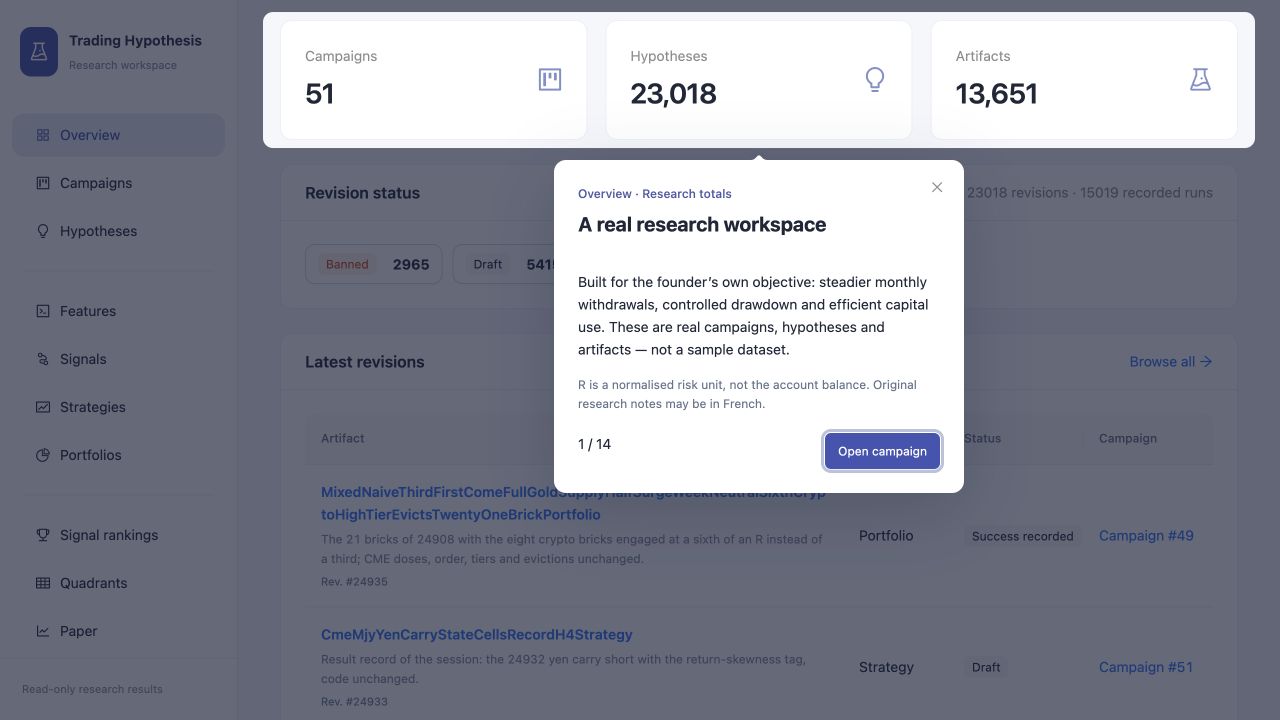
A private guided walkthrough shows how hypotheses, revisions and evaluations fit together. The examples come from my own research; your engagement starts with yours.

Actual research dashboard showing campaigns, hypotheses and artifacts, with the first step of the guided walkthrough open.
What kind of research is a fit?

Systematic signals, strategies and portfolios around agreed instruments, data and constraints. We scope new data and execution integrations separately. High-frequency and order-book research can also be discussed. They require a separate, funded development scope, with technical requirements, budget and implementation time agreed before work begins; they are not part of the standard setup.

Does this include running our trading account?

The service is focused on conducting research. Your team retains deployment decisions and day-to-day trading operations. Historical-only research, live integrations and porting into your systems can be discussed as separate scopes.

What if the research rejects the idea?

You still receive the work and the reasoning. Research may support, revise or reject an idea. It does not guarantee a profitable strategy or future returns.

Let’s start with the question

What would you
like to find out?

Tell us what your team wants to investigate
and which decision the work should inform.

Discuss your research
Start a conversation, or explore the research environment first.

A closer look

See how the
research works.

We’ll arrange private access to the guided walkthrough. It shows our own research environment, with examples of the process and its evidence.

Prepare an email

Opens your email app. Nothing is sent from this page.